
Introduction Lesson: Syilx Worldview
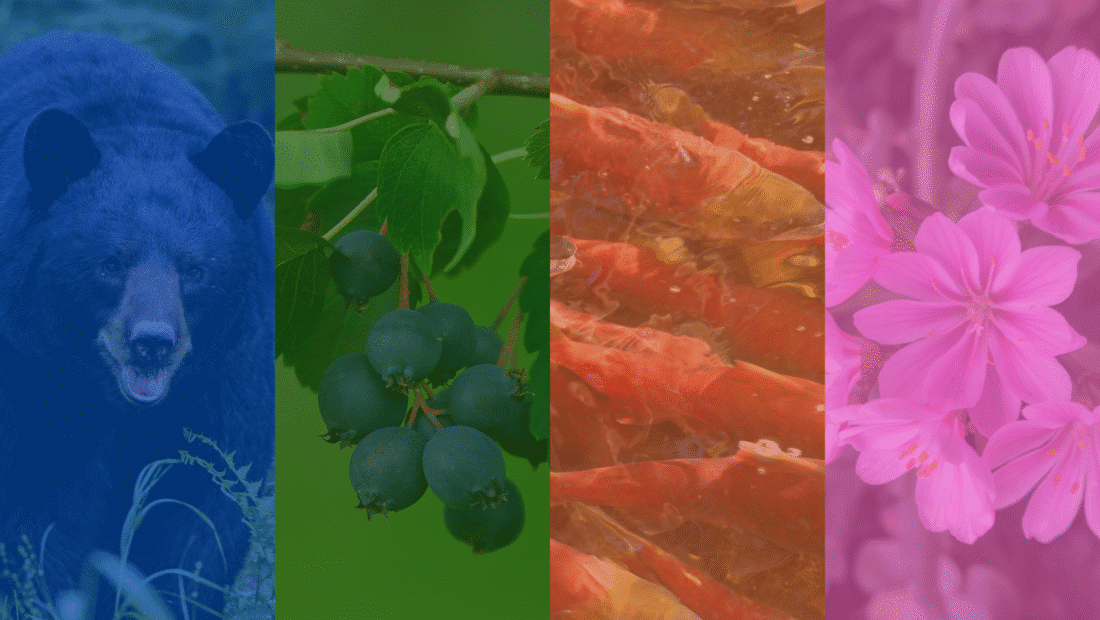
The Syilx Nation’s worldview emphasizes interconnectedness, viewing nature relationally without distinction between animate and inanimate beings, including land, animals, and people.
Please review full curriculum in the PDF at the bottom of the page to gain full understanding of the lesson and activity.
Four Food Chiefs
The Four Food Chiefs represent a “cultural practice that is used in order to include all views in the discussions that lead to resolving conflicts, making decisions, and developing plans for taking action as a collective with all perspectives represented and considered” – Syilx siwɬkʷ Strategy
- ylmixʷəm skəmxist – Chief Black Bear
- ylmixʷəm ntytyix – Chief Salmon
- ylmixʷəm siyaʔ – Chief Saskatoon Berry
- ylmixʷəm spʼiƛ̓əm – Chief Bitterroot
In this captikwɬ, kul’nchut’n sent senk’lip (Coyote) to prepare for the future of the stelsqilxw (People-To-Be). The Four Chiefs: skəmxist (Black Bear), siyaʔ (Saskatoon Berry), spʼiƛ̓əm (Bitterroot), ntytyix (King Salmon) then came together and made a plan for how to feed stelsqilxw. Each of the characters and their actions in the story are representative of various protocols, social order and life lessons that dictated the way of life of the Syilx people prior to outside contact.
Differing perspectives of the Four Chiefs were brought together to inform the discussion, the problem solving, the decision making and the action plan. This is our creation story and now serves as a governance model that the Syilx still use today.
Interconnectedness: Syilx Okanagan Peoples’ Worldview
The Syilx Nation’s worldview embraces interconnectedness. Essential understandings of nature are based on a relational view of the world with no distinction between animate and inanimate beings (land, animals, people). Water is at the root of the Syilx existence.
siwłkw flows around us, under us, and through us, connecting us to one another and our ancestors. By going to siwłkw, it knows who we are and creates the connection that reaches through generations. This ancient and inherent bond has sustained the Syilx People for countless generations and is a cornerstone of their material, cultural, and spiritual identity.
On-the-Land Learning Opportunity: How Can You Become a Local Water Protector?

Participate in the kł cp̓əlk̓ stim̓ Hatchery Tour
The kł cp̓əlk̓ stim̓ Hatchery in Penticton is a testament to the perseverance of the Syilx People to realize their dream of restoring the ntytyix (Salmon) – one of the Four Food Chiefs – to their original habitat and rightful place in their territory. This hatchery represents a critical stage in the Nation’s effort to restore the historical range of sockeye in the upper Okanagan watershed, (including the Skaha and Okanagan Lake systems) and a portion of the Columbia River Basin.
Best time for a tour: November–June
On-the-Land Learning Opportunity: Sharing captikʷł by the Water
Take your students to the closest water source and read to them.

Suggestion: Lazy Boy is a Syilx captikʷł which tells us about a journey of a boy who learns about self-care, wellness and giving back to community (available at ONA’s bookstore).
Messages in the story include the skills and values important to the Syilx community. Students can make lists and then discuss with partners to see what are the similarities and differences in their understanding of the story.
Find the audio story as read by Paul Alexis:

Reference Book
Okanagan Elders Council and Illustrated by Barbara Marchand, Kou-Skelowh/ We Are The People (Penticton: Theytus Books Ltd, 1984) – Also called How Food was Given (or Four Food Chiefs)